Big Staffing Agencies vs Local Specialists: Why Local Knowledge Matters
By Care Steps Australia
By Care Steps Australia | Last updated: 24 October 2026
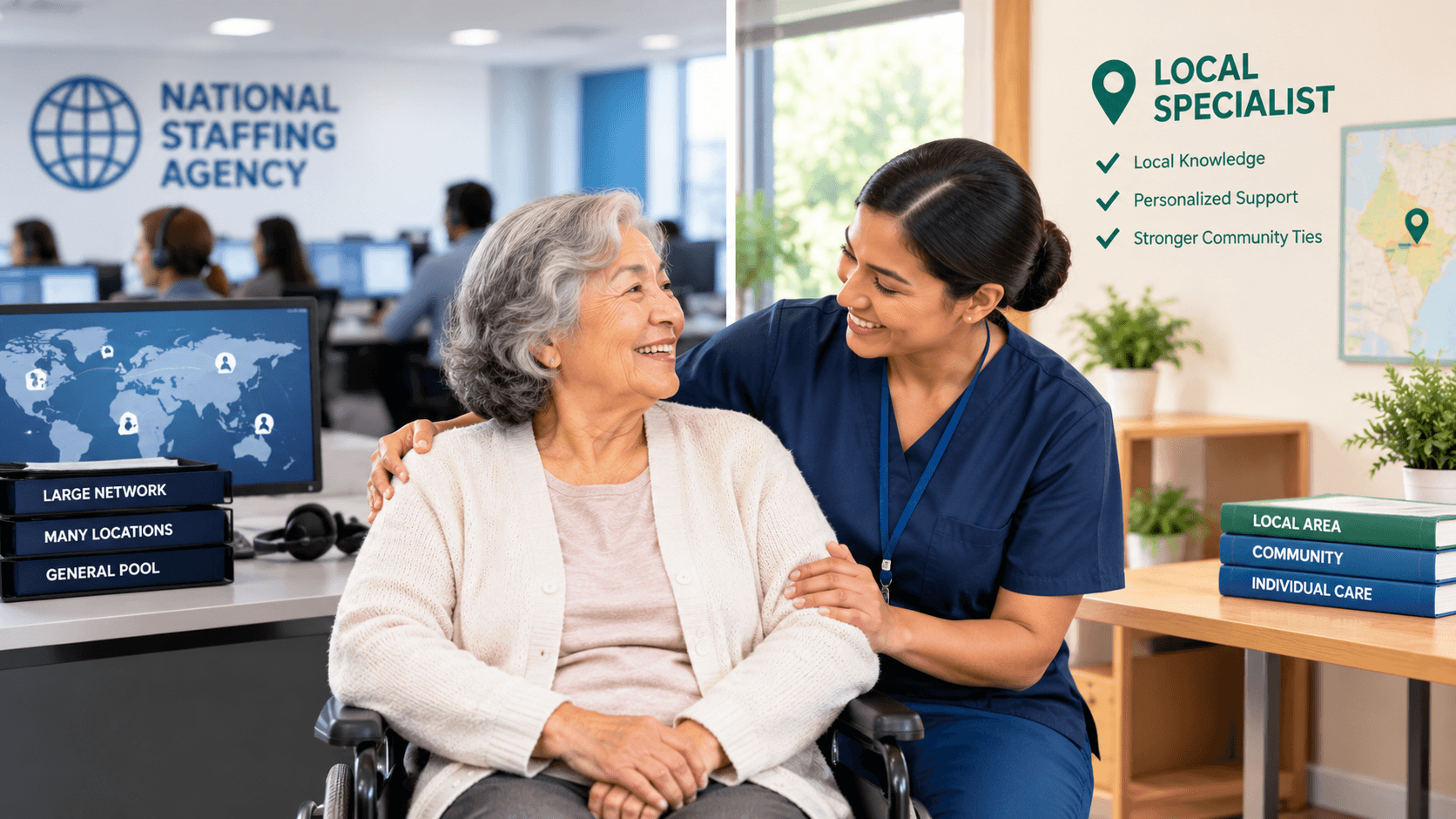
Big staffing agencies offer larger worker pools, wider coverage and often permanent recruitment. Local specialists offer workers who know the area, its languages and often the participants themselves, which matters most for continuity and culturally matched care. In Canterbury-Bankstown, 67.8% of households use a language other than English, compared with 29.5% across NSW.
Key Takeaways
- Choose by situation, not by size. Big agencies suit multi-site, statewide and permanent hiring. Local specialists suit continuity, complex participants and culturally matched care.
- Local knowledge is measurable. Each south-west Sydney council area has a different language mix, according to the 2021 Census.
- The compliance baseline is the same for every agency, big or small. Ask for evidence rather than assume it.
- Many providers use both: a large agency for permanent recruitment and a local specialist for gaps and complex shifts.
- Care Steps Australia supplies casual aged care and NDIS staffing in south-west Sydney from its own workforce. It does not do permanent placements.
Big Agency vs Local Specialist: What's the Difference?
A big staffing agency usually works across many regions and sectors, often combining casual shift supply with permanent recruitment. A local specialist works in a small area and a narrow set of services, usually aged care and disability support, and supplies casual or short-term workers who live and work in that area. The difference shows up in who arrives on shift and how well they know the setting.
Side-by-Side: What to Compare
Use this table in your next call with any agency. The right column tells you what to ask, whichever type you are speaking to.
What "Local Knowledge" Actually Means
Local knowledge is more than a postcode. It covers five practical things a worker brings to a shift.
Why It Matters in South-West Sydney: The Language Data
South-west Sydney is not one community. The 2021 Census shows that the share of residents who speak only English at home, and the top languages spoken, change sharply between neighbouring council areas.
Source: Australian Bureau of Statistics, 2021 Census QuickStats for Canterbury-Bankstown, with the Liverpool and Campbelltown QuickStats.
A worker who speaks Arabic is a strong match for many clients in Bankstown. In Campbelltown, Bengali and Nepali appear among the top languages. An agency that knows these differences can match workers to clients, not just to shifts.
Which Is Better for Your Situation?
Match your staffing need to the type of agency that usually fits it best.
When a Big Agency Is the Better Choice
If you run sites across several regions, need one supplier for every location, or want permanent recruitment alongside casual cover, a large agency is often the practical choice. A wide coverage area and a single contract can simplify procurement for multi-site groups. Ask the same questions about continuity and language fit, because size alone does not answer them.
Where Local Specialists Fall Short
Local specialists have real limits. Their worker pool is smaller, so very large or sudden volume can stretch them. Their coverage area is narrow, so a site just outside it may not be served. Many, including Care Steps, do not offer permanent recruitment. Ask any local agency where its coverage ends and what happens when its pool is fully booked.
Continuity of Care: Why the Same Face Matters
For many older people and NDIS participants, a new face on every shift is unsettling. A worker who returns already knows the routine, the communication style and the triggers to avoid, so the shift starts calmly. For participants with behaviour support needs, familiarity is part of the support itself. Our guide to disability and aged care staffing in Sydney explains how experience-based matching works for complex placements.
Compliance: The Same Rules Apply to Both
Agency size does not change the screening rules. Aged care workers must hold a valid clearance under the Australian Government's aged care workforce screening requirements, and NDIS workers in risk-assessed roles need an NDIS Worker Screening Check. A big agency is not automatically more compliant, and a small one is not automatically less. Ask for evidence per worker. Our article on how we screen our carers and nurses lists each check, and our guide to the NDIS Practice Standards for staffing partners covers what NDIS providers must check.
10 Questions to Ask Any Staffing Agency
- Which suburbs do you cover today?
- Do you supply casual workers, recruit permanent staff, or both?
- How many of your workers have recent aged care or NDIS experience?
- Can you match a worker who speaks our client's language?
- Can the same worker return for repeat shifts?
- How do you brief workers on our care notes before a shift?
- How do you match workers to behaviour support or complex needs?
- Can you show current screening and qualification evidence for each worker?
- Who do we contact if a shift goes wrong, and how fast do you respond?
- What happens when your pool is fully booked?
How to Test an Agency Before You Commit
Start with a single shift rather than a large contract. Before the shift, check how the agency asks for your care notes. On the day, note whether the worker arrives on time, has read the notes and follows your escalation process. Afterwards, ask whether the same worker can return. One well-run shift tells you more than a sales call.
Using Both: The Hybrid Approach
Many providers do not choose one. They use a large agency or recruitment firm for permanent hiring, and a local specialist for short-notice gaps, SIL and STA cover, complex participants and culturally matched shifts. This keeps permanent recruitment broad while day-to-day continuity stays local.
Where Care Steps Fits, and Where It Doesn't
Care Steps Australia supplies short-term, casual, ad-hoc and temporary workers from its own workforce to residential aged care, home care and NDIS providers. Our workers hold police checks, Working with Children Checks, NDIS Worker Screening Checks, current qualifications and insurance.
Where we don't fit: we don't recruit permanent staff, and our coverage is focused on Punchbowl, Bankstown, Liverpool, Campbelltown and Campsie. See the full Care Steps workforce solution for how it works.
Talk to a Local Staffing Specialist
If you have a staffing gap at a site in south-west Sydney, contact our team to talk it through.
Care Steps Australia 48 Lancaster Avenue, Punchbowl NSW 2196 Phone: (02) 8201 3100 Email: info@carestepsaustralia.com.au Find us on Google Maps: https://maps.app.goo.gl/ZsJQgwvKcMMUVb1MA
In Short
Big staffing agencies suit multi-site, statewide and permanent hiring. Local specialists suit last-minute gaps, continuity, complex participants and culturally matched care, which matters in south-west Sydney, where the language mix changes from one council area to the next. The compliance rules are the same for both, so ask every agency for evidence. For casual aged care and NDIS staffing in Punchbowl, Bankstown, Liverpool, Campbelltown and Campsie, call Care Steps Australia on (02) 8201 3100.
Sources checked 24 October 2026: Australian Bureau of Statistics, 2021 Census QuickStats (Canterbury-Bankstown, Liverpool, Campbelltown); Department of Health, Disability and Ageing, screening requirements for the aged care workforce.
FAQ
A recruitment agency finds permanent employees who join your payroll. A staffing agency supplies workers for short-term, casual or temporary shifts, and the workers remain with the agency. Care Steps is a staffing agency: it supplies casual workers from its own team and does not make permanent placements.
It is worth it when unplanned absences, sick leave or no-shows leave gaps you cannot fill from your own roster. An agency removes the time spent ringing around for cover and keeps care going while your permanent team is short. It works best when the agency's workers meet the same standards as your own staff.
Not always. Aged care workers need either a police certificate no older than three years that does not record certain offences, or an NDIS Worker Screening Check. If a worker holds an NDIS Worker Screening Check, they do not also need a police certificate. Workers in risk-assessed roles for registered NDIS providers must hold the NDIS check.
No. Your registration status governs what your organisation can deliver directly, and how participants' plan management types limit which providers they can use. It does not stop you bringing in casual, compliance-checked staff through an agency to cover a shift.
It depends on the agency's pool, your location and how much notice you give. Care Steps aims for same-day or next-shift cover for urgent needs, depending on availability and location. Shifts that need a specific experience match, such as behaviour support, benefit from a little more lead time.
Tell the agency straight away. At Care Steps, a genuine gap in the experience a shift needed is addressed immediately, for example by confirming a worker with the right experience for future shifts or updating the participant's notes so the next worker is better briefed.
Related service
Our Workforce Solution →Need vetted carers, support workers or registered nurses for your organisation?
Contact our team