Culturally Sensitive Disability Care for CALD Communities in Sydney
By Care Steps Australia
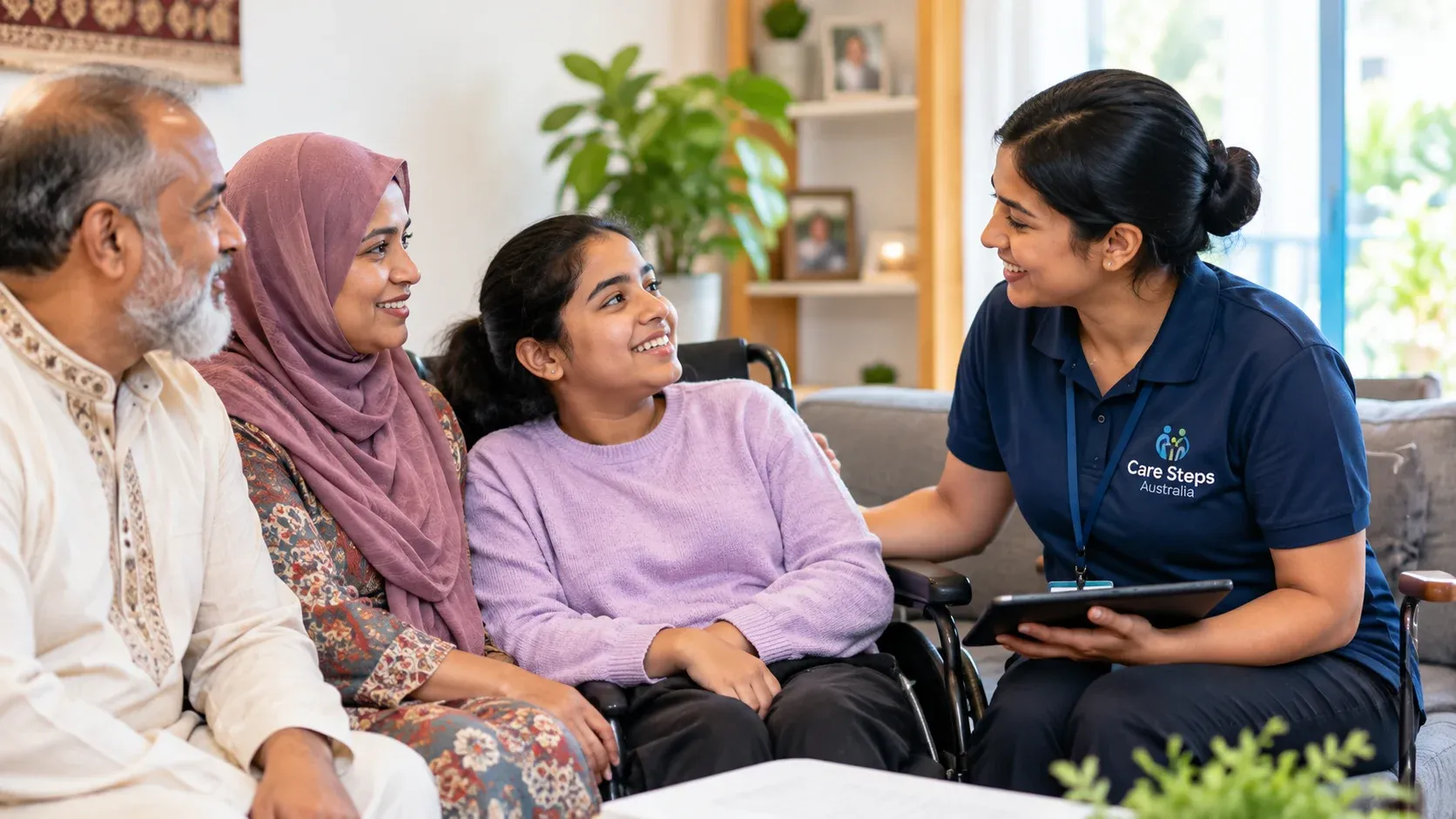
Culturally sensitive disability care means a provider adapts to your language, cultural practices, and family structure, rather than expecting you to adapt to theirs. In the NDIS, this includes free interpreter access, understanding of cultural and religious needs in daily support, and respect for who is involved in your care decisions. Here's what that looks like in practice, and how to find it.
Key Takeways :
- Free interpreters are available at every stage of your NDIS journey through TIS National, at no cost to you or your carer.
- Culturally aware care covers language, dietary and religious observance, and how your family is involved in decisions, not just who delivers the service.
- Care Steps Australia supports CALD families across Punchbowl, Bankstown, Lakemba, Campsie, and Greenacre. Call (02) 8201 3100 to talk to someone who understands what you need.
What Does Culturally Sensitive Disability Care Actually Mean?
Culturally sensitive disability care means the provider changes how it delivers support to fit your background, not the other way around. That sounds simple, but in practice it covers a lot of ground: the language support is delivered in, whether religious and dietary requirements are respected in daily routines, how much say your extended family has in decisions, and whether a support worker understands why certain customs matter to you without needing them explained every time.
Most guides on this topic mention cultural sensitivity in a single sentence before moving on to something else. That's not enough for a family trying to work out whether a specific provider will actually get it right. Culturally sensitive care is not a checkbox or a policy statement, it's whether the person supporting you day to day understands your context well enough that you don't have to keep re-explaining it.
For NDIS participants and aged care recipients from culturally and linguistically diverse, or CALD, backgrounds, this matters for a practical reason: a mismatch between provider and family expectations shows up in small but constant friction, meals that don't fit dietary needs, decisions made without the right family members present, or a support worker who is technically competent but culturally out of step. None of that is a reflection on the participant. It's a sign the provider hasn't built cultural understanding into how support is actually delivered.
The rest of this guide walks through what that looks like in Punchbowl and south-west Sydney specifically, how to access free interpreters, and what to ask any provider before you commit.
Why Does This Matter More in Punchbowl and South-West Sydney?
South-west Sydney, including Punchbowl, Bankstown, Canterbury-Bankstown, Lakemba, Campsie, and Greenacre, is one of the more culturally diverse parts of the country, which is exactly why this issue plays out differently here than it does in a less diverse area. Nationally, 27.6% of Australians were born overseas and 22.8% speak a language other than English at home, according to the Australian Bureau of Statistics' Cultural diversity of Australia data, based on the 2021 Census. In an area like south-west Sydney, that diversity is a lived, everyday reality, not a statistic on a page.
For families here, this isn't an abstract equity issue, it's a practical one. If a support worker doesn't understand why a family gathers for major decisions, or doesn't know how to work around dietary or prayer requirements, the disruption is felt every week, not once. Providers who treat cultural understanding as a genuine part of service delivery, not an add-on, are a real point of difference in an area where most families are navigating exactly this.
At Care Steps Australia, this isn't a policy statement written for a website. Our team speaks multiple languages and understands various cultures, norms, and traditions, so clients feel comfortable and respected in their own home. We support CALD communities across Australia, and some of our own team members' families have been recipients of government-funded aged care and disability support themselves. That shared experience means we relate to what you're going through, not just administer a service around it.
What Real Barriers Do CALD Families Face?
The barriers CALD families run into with the NDIS and aged care system are consistent, even if they're rarely explained in full. Language is the most obvious one, but it isn't the only one. Many families are unfamiliar with how the NDIS system actually works, its terminology, its planning process, and its review cycles, which is disorienting even for English-speaking participants navigating it for the first time. On top of that, some families carry a degree of distrust built from past experiences with services that didn't understand or respect their background.
These barriers matter because CALD participation in the NDIS remains genuinely low relative to the broader population. As of 1 March 2026, only 9% of active NDIS participants, 67,501 of 774,456 nationally, identified as culturally and linguistically diverse, according to the NDIS Quarterly Report. Set against the 27.6% of Australians born overseas nationally, that gap is real and worth naming rather than glossing over.
None of these barriers are about a family's willingness to seek support. They're about whether the systems and providers around them are actually built to be accessible. Interpreter access, covered next, is one of the most practical and immediate ways that gap gets closed.
How Do You Access a Free Interpreter for NDIS Support?
Interpreter access for NDIS participants is one of the more practical pieces of information families often can't find in one place. Here's how it works. Interpreting is delivered by TIS National on behalf of the NDIS, and NDIS participants and carers are not charged for language interpreting services, according to NDIS's own guidance on language interpreting services. TIS National contracts more than 3,000 certified interpreters across more than 160 languages, so most language needs can be met.
Interpreter support is available at key points in your NDIS journey, including when you're first applying for the NDIS and gathering evidence, during your planning meeting, and as you implement your plan with providers day to day. It's worth being clear about what an interpreter does and doesn't do: they translate the conversation accurately, they don't give NDIS advice or make decisions on your behalf. If you need an interpreter for a planning meeting, a review, or an ordinary appointment with your provider, you or your provider can arrange this through TIS National ahead of time, so it's worth raising early rather than on the day.
If you're not yet sure whether you or a family member meets the NDIS's criteria, it's worth checking your eligibility before working through the access process, since interpreter support applies from the very first step.
What Does Culturally Aware Care Look Like Day to Day?
Culturally aware care shows up in the details of daily support, not in a mission statement. It means dietary requirements, halal, vegetarian, or otherwise, are actually planned for rather than worked around at the last minute. It means religious observance, prayer times, fasting periods, or specific rest days, is factored into how a support schedule is built, not treated as an inconvenience. It means gender preferences for personal care are respected where they matter to the participant or family, and that a support worker understands the reasoning behind a custom well enough not to need it explained every visit.
It also means communication style matters as much as language itself. Some families expect directness, others expect a support worker to defer more to family elders in a conversation. Getting this wrong doesn't require bad intent, it usually just means the provider hasn't taken the time to understand how a specific family operates. Getting it right is less about ticking boxes and more about a support worker who pays attention and adjusts.
This is the level of detail that turns a support arrangement from merely adequate into one a family actually trusts.
What Questions Should You Ask a Provider About Cultural Support?
Before committing to any provider, home care, NDIS, or aged care, a short conversation can tell you a lot about whether they'll actually deliver culturally aware support. Worth asking directly:
- Do you have support workers who speak my language, or can you arrange an interpreter at no cost to me?
- How do you plan for dietary or religious requirements in day-to-day support?
- How is my family involved in decisions about my care, and can specific family members be part of planning conversations?
- Have your support workers worked with families from my cultural background before?
- What happens if a support worker doesn't understand something about my culture, how do you handle that?
A provider that can answer these clearly and specifically, rather than with a general reassurance, is one worth taking seriously. A provider that seems unsure or defensive is worth thinking twice about.
How Do Family and Extended Networks Fit Into Care Decisions?
In many CALD communities, care decisions aren't made by one person in isolation, they're made with input from parents, adult children, or extended family, sometimes across generations. This is a normal, expected part of how care decisions work, not an exception a provider needs to be talked into accommodating.
A culturally aware provider builds this into how it operates: making space for the right family members in planning meetings, communicating updates in a way that respects who the family wants informed, and not treating a participant's preference for family involvement as unusual. This matters just as much for aged care as it does for the NDIS, since family involvement in decisions is often even more central in aged care contexts.
Getting this right isn't about a provider deferring to family over the participant's own wishes, it's about recognising that for many families, those two things aren't in tension. Support that respects both is support that actually fits how the family already operates.
How Does Care Steps Australia Support CALD Families?
Here's what we can tell you plainly. Our team speaks multiple languages and understands a wide range of cultures and traditions, so clients and families feel understood, not just serviced. We support CALD communities across Australia, and some of our own team members' families have themselves relied on government-funded aged care and disability support, which means the understanding we bring isn't theoretical.
We provide NDIS and aged care support across Punchbowl, Bankstown, Liverpool, Campbelltown, Campsie, Lakemba, and Greenacre. If you want to know whether we can support your specific language or cultural needs, the most useful next step is a direct conversation, since that's a better way to get a real answer than a generic list on a website.
Where to Get Help
In Short
Culturally sensitive disability care means a provider adapts to your language, cultural practices, and family structure, not the other way around. Free interpreters are available at every stage of your NDIS journey through TIS National, and a genuinely culturally aware provider builds dietary, religious, and family-decision-making needs into daily support, not just a policy page. In Punchbowl and south-west Sydney, where cultural diversity is a lived reality for most families, that understanding shouldn't be something you have to search hard to find.
Looking for Culturally Aware Disability or Aged Care Support?
Our team supports CALD families across Punchbowl, Bankstown, Liverpool, Campbelltown, Campsie, Lakemba, and Greenacre with people who understand the value of shared cultural experience, not just service delivery. Learn more about our NDIS support services in Punchbowl or get in touch to talk to someone directly.
Care Steps Australia 48 Lancaster Avenue, Punchbowl, NSW 2196 Phone: (02) 8201 3100 Find us on Google Maps: https://maps.app.goo.gl/ZsJQgwvKcMMUVb1MA
Frequently Asked Questions
CALD stands for culturally and linguistically diverse. In the NDIS, it refers to participants whose cultural background, language, or both differ from the English-speaking majority, and who may need interpreter support or culturally aware service delivery to access disability support effectively.
Yes. Interpreting is delivered by TIS National on behalf of the NDIS, and NDIS participants and carers are not charged for the service.
Interpreter support is available when you're applying and gathering evidence, during your planning meeting, and as you implement your plan with providers day to day.
You can ask any provider directly whether they have support workers who speak your language or have experience with your cultural background. A provider that takes cultural fit seriously should be able to answer this clearly.
A culturally aware provider treats family and extended-network involvement as a normal part of how care decisions are made, not an exception, and makes space for the right family members in planning conversations where that's what the participant and family want.
Ask how they plan for dietary and religious requirements, whether they have experience with your cultural background, how family is involved in decisions, and what happens if a support worker doesn't understand something about your culture.
Our team speaks multiple languages and supports CALD communities across Australia, and some of our own team members' families have relied on government-funded aged care and disability support themselves. For your specific language or cultural needs, the most accurate answer comes from a direct conversation with our team.
Culturally aware care matters just as much in aged care as it does under the NDIS. Family involvement in decisions, dietary and religious observance, and language support are relevant across both.