
Registered Nurse vs Support Worker: Who Handles Your NDIS Clinical Care?
By Care Steps Australia
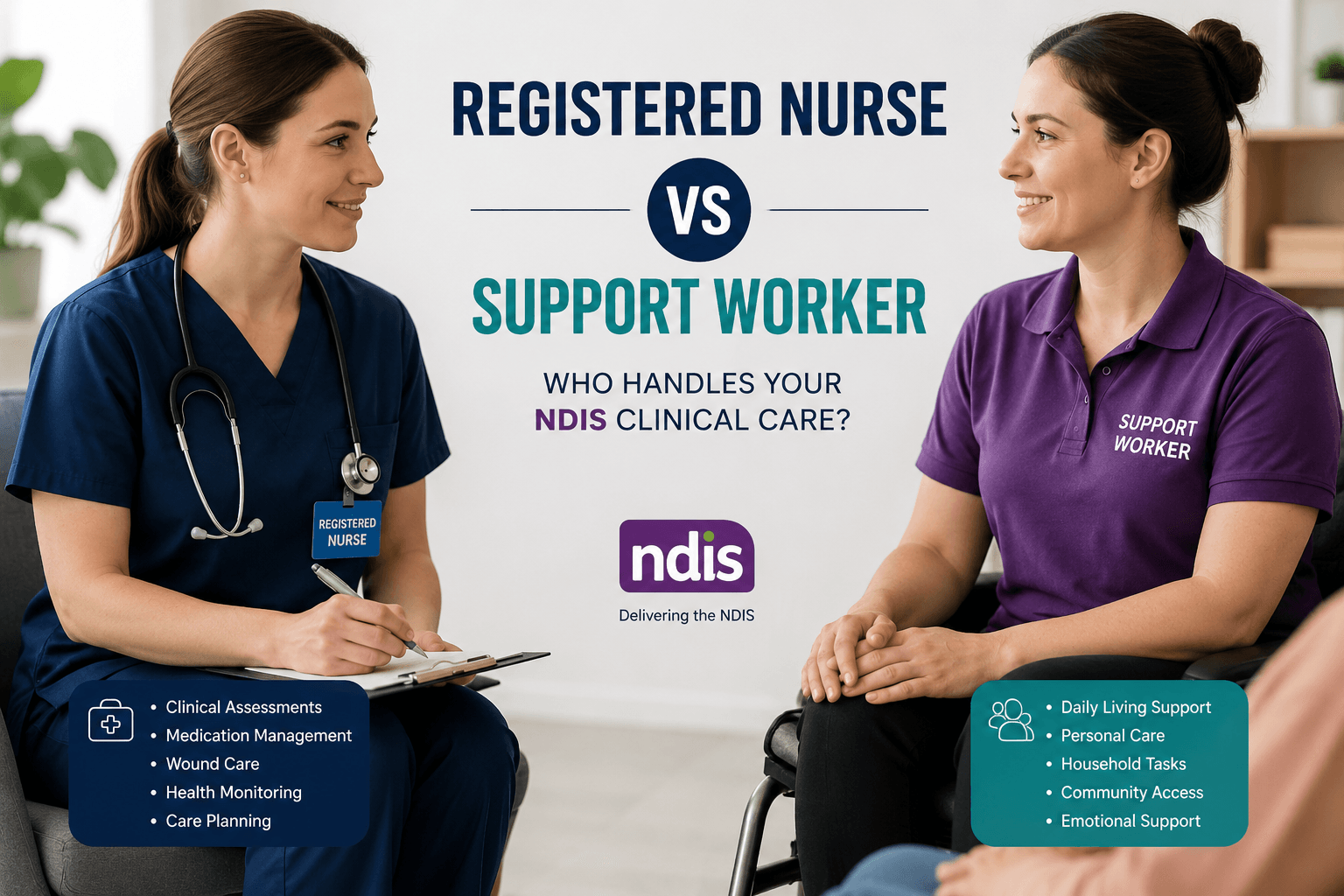
Registered Nurse vs Support Worker? A registered nurse handles clinical tasks like wound care, medication administration, catheter care, and health monitoring. A support worker handles personal care, daily living support, and community participation. These roles are legally separate, a support worker cannot be delegated a nurse's clinical work, even if a plan has funding earmarked for it.
Key Takeaways
- Clinical tasks (wound care, medication administration, catheter care, injections, health monitoring) require a registered nurse.
- Non-clinical tasks (showering, dressing, meal prep, transport, community participation) are a support worker's role.
- This is a legal boundary, not just a preference. AHPRA's Code of Conduct does not allow a registered nurse to delegate clinical work to a disability support worker.
- A 2022 Full Federal Court decision confirmed the NDIS cannot fund a model where support workers are delegated a registered nurse's clinical responsibilities.
- Good NDIS providers use both roles together, each doing exactly what they're qualified for, with clear clinical oversight.
Table of Contents
- The Core Difference in One Table
- What a Registered Nurse Actually Does
- What a Support Worker Actually Does
- Why This Is a Legal Distinction, Not Just a Preference
- Can My Support Worker Be Trained to Do Clinical Tasks?
- What This Means for Your NDIS Plan
- Questions to Ask Any NDIS Provider
- For Sydney South West Families
- Frequently Asked Questions
The Core Difference in One Table
What a Registered Nurse Actually Does in Your NDIS Care
A registered nurse provides the clinical layer of your care. This includes wound care and dressing changes, medication management (including injections and anything placed in the mouth), catheter and continence care, and ongoing clinical observation, tracking how a health condition is trending and flagging concerns early. Nurses also liaise directly with GPs and specialists when a participant's condition changes, something outside a support worker's scope entirely.
If you're still working out whether your plan covers this kind of support, our guide on what NDIS community nursing care actually is breaks down exactly what falls under nursing versus general support.
What a Support Worker Actually Does in Your NDIS Care
A support worker's role is practical and person-centred: showering, dressing, and personal hygiene, meal preparation and household tasks, transport to appointments, and helping participants stay connected to their community. This work is just as essential to a good quality of life, it's simply a different scope, focused on daily living and independence rather than clinical treatment. Our earlier guide on the 10 things NDIS community nursing actually covers goes deeper into where the clinical side picks up.
Why This Is a Legal Distinction, Not Just a Preference
This isn't a matter of provider preference or cost-cutting, it's a legal boundary. A registered nurse's AHPRA Code of Conduct does not allow them to delegate genuine clinical work to a disability support worker.
This was tested directly in Australian courts. In National Disability Insurance Agency v KKTB, by her litigation representative CVY22 [2022] FCAFC 181, the Full Federal Court dismissed an appeal by the National Disability Insurance Agency, upholding three Tribunal decisions that had found participants with severe to profound disabilities needed a registered nurse, not a disability support worker, for the level of clinical support their plans required. The case confirmed that the level of support required from registered nurses, as opposed to disability support workers, is a real, tested legal question, not just an internal provider policy.
In practical terms: if a provider suggests a support worker can take over a genuinely clinical task to save money or fill a roster gap, that's a compliance red flag, not a convenience.
Can My Support Worker Be Trained to Do Clinical Tasks?
Some tasks sit in a middle ground. A trained, authorised support worker can prompt or supervise medication self-administration, and in some cases assist with minor, non-invasive wound care under specific conditions and clear delegation from a nurse. What they cannot do, regardless of training, is perform genuine clinical procedures such as injections, catheter care, or placing medication in a person's mouth. If a task requires clinical judgement or carries a real health risk if done incorrectly, it belongs to a nurse.
What This Means for Your NDIS Plan
NDIS plans typically fund nursing and support-worker services under different categories, clinical nursing usually sits under Assistance with Daily Life (Nursing), while personal care and community participation sit under Core Supports. If you're not yet sure whether you qualify for NDIS support at all, our guide on NDIS eligibility criteria covers the full requirements before you get to this stage. Once you have a plan, your support coordinator can help make sure both categories are funded appropriately for your actual clinical needs.
Questions to Ask Any NDIS Provider
Before you commit to a provider, ask directly:
- Who specifically will be doing my wound care or medication management, a nurse or a support worker?
- Is my support worker trained and authorised for the specific tasks they're doing with me?
- How does your organisation supervise clinical versus non-clinical staff?
- What happens if my health needs change and I suddenly need more nursing input?
A provider that answers these clearly and doesn't hesitate is one that takes the legal distinction seriously.
For Sydney South West Families
Care Steps Australia is led by a clinically experienced management team based in Punchbowl, serving families across Sydney's south-west including Bankstown, Lakemba, and Campsie. Our support workers and nurses each work within their own scope, with clear clinical oversight, so you always know who's doing what and why.
About This Guide
Written by Merina Suwal, Director and Clinical Services Specialist at Care Steps Australia, a registered NDIS provider based in Punchbowl serving Sydney's south-west. Last updated August 3, 2026.
Get the Right Support for Your Needs
If you're not sure whether your NDIS care needs a nurse, a support worker, or both, Care Steps Australia can help you work it out. Contact our clinically led team today.
Frequently Asked Questions For Registered Nurse vs Support Worker
A trained, authorised support worker can prompt or supervise you taking your own medication. Injections, PEG feeds, or placing medication in your mouth require a registered nurse.
Only minor, non-invasive tasks under specific training and a nurse's delegation. Genuine wound care and dressing changes require a registered nurse.
It's a real legal boundary, not just informal guidance. A 2022 Full Federal Court decision confirmed the NDIS cannot fund a model where support workers take on a registered nurse's clinical responsibilities, and AHPRA's Code of Conduct prevents nurses from delegating that work in the first place.
Yes. This is common and often the best setup, a nurse handles clinical tasks while a support worker handles daily living and community participation, each within their own scope.
If the task involves a medical procedure, medication beyond prompting, or monitoring a health condition, it needs a nurse. If it's about daily living, personal care, or staying connected to your community, a support worker is the right fit.
Related service
Clinical & community nursing →Our registered nurses provide wound care, medication support and health monitoring at home.
Request a call back
Tell us a little about the support you need and our team will call you back during business hours. Prefer to talk now? Call 02 8201 3100.


Led by Rosy Thapa (Aged Care Specialist) & Merina Suwal (Clinical Services Specialist), each with 10+ years in aged care and clinical nursing.
- ✓ Registered NDIS provider - approved to Aug 2028 (verify)
- ✓ Registered aged care provider
- ★ 5.0 Google rating - read our reviews