What Is NDIS Community Nursing Care? A Plain-English Guide for Sydney Families
By Care Steps Australia

NDIS community nursing care is clinical support delivered at home by a registered or enrolled nurse for participants whose health needs are linked to their disability, things like wound care, medication management, or monitoring a chronic condition. It differs from a support worker's help with daily tasks, and it's funded through your NDIS plan, not paid for separately.
Key Takeaways
- A nurse, either a Registered Nurse or an Enrolled Nurse, delivers this care, not a support worker.
- It is for clinical needs tied to your disability, not general daily help like showering or meal preparation.
- It is funded through your NDIS plan, usually under Core Supports or Capacity Building.
- Sydney south west families in Punchbowl, Bankstown, Campsie, and nearby suburbs can access this care locally without repeated trips to hospital for routine clinical needs.
- Have questions about your own situation? Call Care Steps Australia on (02) 8201 3100 to talk it through directly.
What is NDIS community nursing care, in plain English?
In plain English: if your family member has a health condition connected to their disability, a nurse comes to your home and manages it directly, things like a wound that needs regular dressing changes, a catheter that needs managing, or a medication routine that needs a trained eye. That means fewer trips to a GP or hospital for routine clinical tasks, and your family member gets that care in a familiar place, from someone who gets to know them over time.
This is different from home care nursing under aged care programs like My Aged Care, and different from a support worker's role. Community nursing under the NDIS is specifically tied to a disability-related health need, delivered by a qualified nurse, and funded through an NDIS plan.
Do you need a nurse or a support worker?
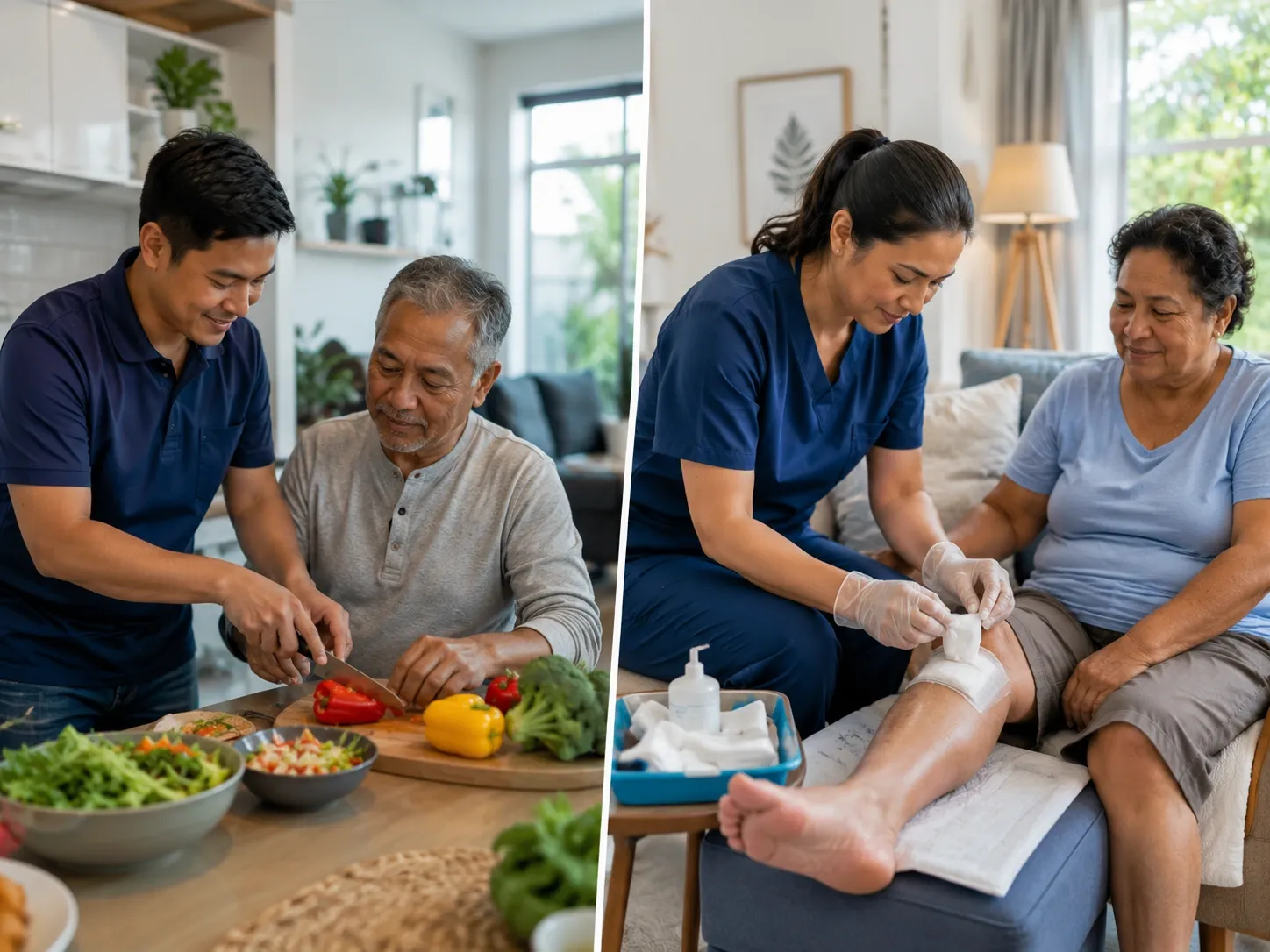
The type of help your family member needs decides who provides it: daily tasks call for a support worker, clinical tasks call for a nurse. Here's how to tell the two apart.
If your family member needs help with | The right person is |
| Showering, dressing, grooming, or personal hygiene | A support worker |
| Meal preparation, cleaning, or getting to appointments | A support worker |
| Community outings, social activities, or building daily living skills | A support worker |
| Wound care, dressing changes, or skin integrity checks | A nurse |
| Catheter, stoma, or continence management | A nurse |
| Injections, complex medication administration, or medication monitoring | A nurse |
| Monitoring a chronic condition such as diabetes or a respiratory condition | A nurse |
Many participants need both. A support worker might help with daily routines while a nurse handles the clinical side, and both can work together as part of one care plan. See Care Steps Australia's NDIS support services for the full range of daily living and personal support options alongside community nursing.
What a community nurse actually does
Depending on your family member's needs, a community nurse can provide:
- Wound care and dressing changes, including monitoring for infection and healing progress
- Medication management, including administering injections, subcutaneous injections, and monitoring for side effects
- Catheter, stoma, and continence care
- Monitoring chronic health conditions such as diabetes, epilepsy, or respiratory conditions
- Health assessments and clinical observation
- Coordination with your family member's GP or specialists when something changes
Depending on a participant's plan and clinical needs, NDIS community nursing can also extend to more specialised areas, including post-surgical nursing support, dysphagia (swallowing) management, PEG and enteral feeding support, tracheostomy care, and palliative care. Not every provider delivers every one of these, so it's worth confirming directly with your provider which specific clinical needs they're equipped to support. Not sure which of these your family member's plan already covers? Send us a service enquiry and we'll walk through it with you.
Registered nurse vs. enrolled nurse: does it matter to you?
A Registered Nurse (RN) holds a nursing degree and full registration with the Australian Health Practitioner Regulation Agency (AHPRA), and can assess a participant's condition independently and build a nursing care plan without needing someone else to sign off. An Enrolled Nurse (EN) also holds AHPRA registration and delivers much of the same hands-on care, but works under an RN's supervision.
In practice, most families do not need to choose between the two. Your provider will match the right level of nurse to the complexity of your family member's needs.
How it's funded in your NDIS plan
Community nursing is paid for through your NDIS funding, not out of your own pocket, the same way a support worker's hours are. It usually sits under Core Supports, for ongoing direct nursing care, or Capacity Building, for nursing support aimed at building skills, such as training you or a family carer to manage a condition independently over time.
The NDIS funds nursing at higher hourly rates than standard support work, since it requires a qualified clinical professional rather than a support worker. According to the NDIS's own guidance on other types of support, disability-related health supports like nursing are funded when they relate to your disability, and the NDIS does not fund care that mainstream health services, like hospitals or GPs, are meant to cover instead.
Providers delivering this kind of clinical support are overseen by the NDIS Quality and Safeguards Commission, the independent regulator that audits registered providers against the NDIS Practice Standards and sets conduct standards for NDIS providers and workers.
What to expect at your first nursing visit
Your first visit starts with an assessment, not treatment. The nurse asks about your family member's health history, current condition, medications, and daily routine, then builds a simple care plan around what's already agreed in the NDIS plan and what your family actually wants to achieve.
You are welcome to be present for visits, ask questions at any point, and request a different nurse if the personality or communication style is not the right fit. A good provider treats that as a normal, reasonable request, not an inconvenience.
For Sydney south west and multicultural families
Families in Punchbowl, Bankstown, Campsie, Lakemba, and the wider Canterbury Bankstown area often want the same reassurance: can we get proper clinical care without constant trips into the city or to a hospital for routine needs. Local community nursing means your family member is seen at home, in their own community, rather than needing to travel for every wound check or medication review.
Language and cultural comfort matter here too. Many families in this part of Sydney speak a language other than English at home, or have specific cultural or religious expectations around who provides personal and clinical care. A good local provider should be able to match a nurse who can communicate clearly with your family, explain what is happening in a way that makes sense, and respect those preferences rather than treating them as an afterthought.
How to get community nursing added to your plan
If community nursing is not already in your family member's NDIS plan, here is the practical path to get it added.
- Talk to your support coordinator or Local Area Coordinator about the specific health need and why a nurse, rather than a support worker, is required.
- Gather evidence from a GP or specialist explaining why the nursing support is necessary and connected to the disability.
- Request a plan review if community nursing is not currently funded, particularly if health needs have changed or hospital admissions could be avoided with proper nursing support at home.
- Once approved, choose a registered NDIS provider to deliver the care and arrange an initial nursing assessment.
Ready to talk it through? Call Care Steps Australia on (02) 8201 3100 or submit a service enquiry and we'll help you work out what your plan needs.
About this guide
This guide was written by Merina Suwal, Director and Clinical Services Specialist at Care Steps Australia, who brings more than 10 years of clinical nursing experience across residential aged care and home care settings, including leading multidisciplinary care teams and overseeing service delivery and compliance. This guide also draws on publicly available NDIS guidance on disability-related health supports and NDIS Quality and Safeguards Commission standards.
Get in Touch
Care Steps Australia
48 Lancaster Avenue, Punchbowl, NSW 2196
Phone: (02) 8201 3100
Email: info@carestepsaustralia.com.au
Contact Care Steps Australia to talk through your family member's needs, or explore the full range of NDIS support we provide across Punchbowl and Sydney's south west.
FAQ About NDIS Community Nursing Care
No. NDIS community nursing is funded through an NDIS plan for people under 65 with a disability-related health need. Aged care nursing at home is generally accessed through My Aged Care and government aged care funding for older Australians. Care Steps Australia provides both, so if you are unsure which applies to your family, it is worth asking directly.
Most providers try to keep a consistent primary nurse assigned to your family member, since continuity helps the nurse understand their needs and history. A backup nurse may attend occasionally during leave, but familiarity with your care plan should carry over.
Some providers offer evening or weekend visits if it is clinically necessary and included in the plan. This varies by provider, so confirm scheduling options directly when you enquire.
Ask your provider directly whether they can match you with a nurse who speaks your language or is familiar with your cultural background. This is a reasonable request, not an inconvenience, and a good provider will take it seriously.
Not automatically. Check your plan document or ask your support coordinator or plan manager. If it is not included but your family member has a genuine clinical need, you can request a plan review to have it added.
There's no fixed schedule. Visit frequency is set during your first nursing assessment and depends entirely on the clinical need, daily for a wound that needs monitoring, a few times a week for medication management, or as-needed for a stable chronic condition. Your nurse and your NDIS plan together determine what's appropriate, and the schedule can be adjusted if your family member's needs change.
A support worker helps with daily living tasks like personal care, meals, and community access. A nurse handles clinical tasks like wound care, medication administration, and monitoring a health condition. Many participants use both, working together as one care team.
No, not if it's included in your NDIS plan, funded nursing hours are paid through your plan the same way support worker hours are, under Core Supports or Capacity Building. Out-of-pocket costs only come up if your funded hours run out before your plan review, or if you're using a service outside what your plan covers, in which case your support coordinator or plan manager can confirm what applies to your situation.
Related service
Clinical & community nursing →Our registered nurses provide wound care, medication support and health monitoring at home.
Request a call back
Tell us a little about the support you need and our team will call you back during business hours. Prefer to talk now? Call 02 8201 3100.


Led by Rosy Thapa (Aged Care Specialist) & Merina Suwal (Clinical Services Specialist), each with 10+ years in aged care and clinical nursing.
- ✓ Registered NDIS provider - approved to Aug 2028 (verify)
- ✓ Registered aged care provider
- ★ 5.0 Google rating - read our reviews