
Registered vs Unregistered NDIS Provider: Why It Matters
By Care Steps Australia
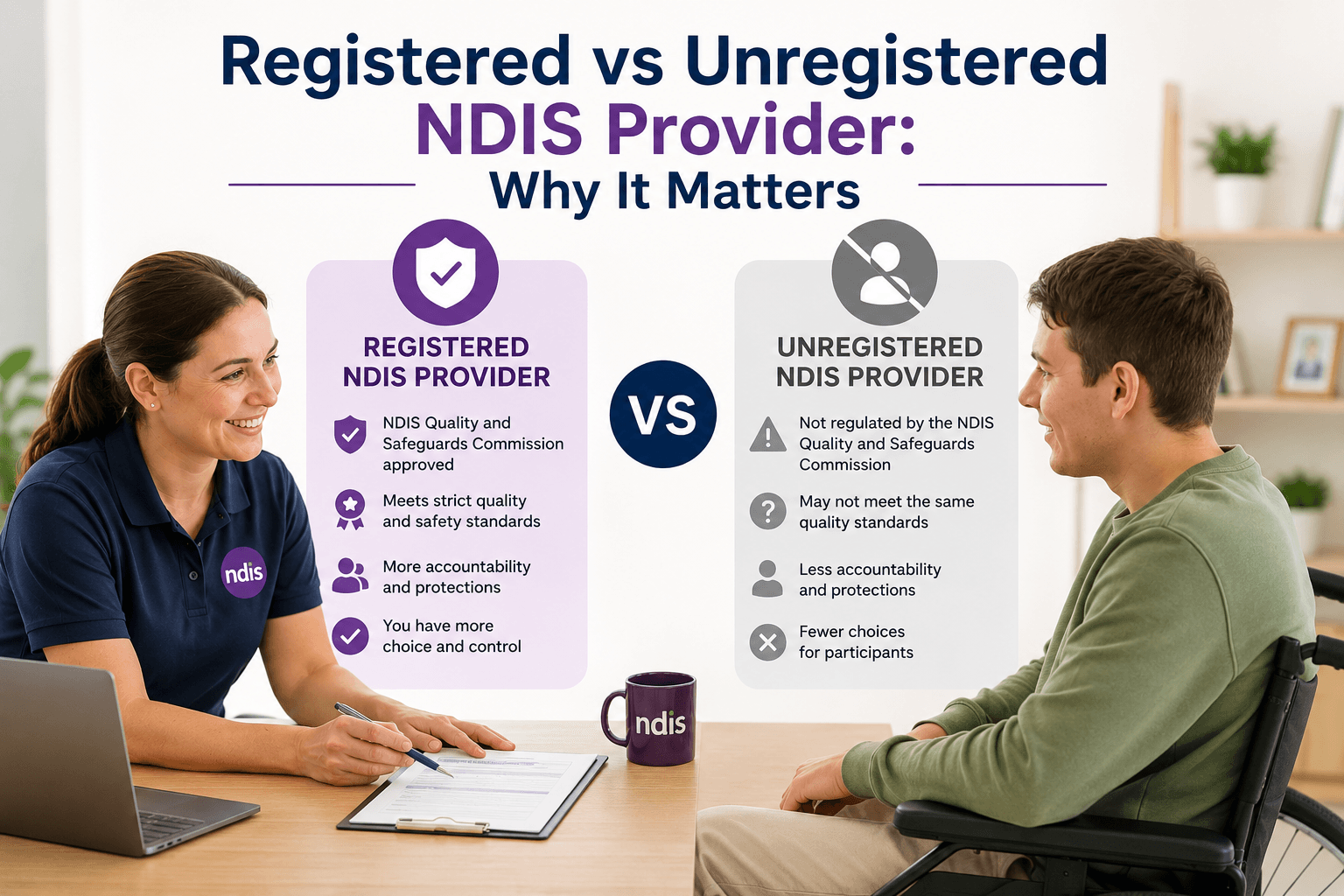
Registered vs Unregistered NDIS Provider: Why It Matters
A registered NDIS provider has completed formal registration with the NDIS Quality and Safeguards Commission and is bound by the NDIS Practice Standards and regular audits. An unregistered provider hasn't completed that process but is still bound by the NDIS Code of Conduct. Which one you can actually use depends on how your plan is managed, and under the PACE system, there's now an added practical step: unregistered providers generally need to be added to your "my providers" list before payments run smoothly.
If you haven't reached this stage yet and are still working through getting your NDIS plan approved, our step-by-step NDIS application guide covers what comes before this decision.
Key Takeaways
- Registration means completing the NDIS Quality and Safeguards Commission's approval process and meeting the NDIS Practice Standards, audits included.
- Unregistered providers aren't unsafe or unregulated, they're still bound by the NDIS Code of Conduct, they just haven't completed formal registration.
- If you're agency-managed, you can only use registered providers. If you're plan-managed or self-managed, you can generally use both.
- Under PACE, unregistered providers usually need to be "endorsed" onto your my providers list before invoices are processed smoothly, a real practical step most older guides don't mention.
- Only registered providers can deliver certain supports, like Specialist Disability Accommodation, Plan Management, and supports involving restrictive practices.
Table of Contents
- What "Registered" Actually Means
- What "Unregistered" Actually Means
- Does Your Plan Management Type Decide This For You?
- What Only Registered Providers Can Deliver
- Price Caps and Invoicing: The Practical Difference
- A Real Cost Example
- How This Works Under PACE in 2026
- A Simple Way to Decide
- What to Check Before You Choose Any Provider
- For Punchbowl & Sydney South West Families
- Frequently Asked Questions
What "Registered" Actually Means
A registered NDIS provider has been through a formal approval process run by the NDIS Quality and Safeguards Commission, the independent body responsible for regulating NDIS providers. To register, a provider must meet the NDIS Practice Standards relevant to the supports they deliver, pass an independent audit, and commit to ongoing compliance monitoring.
This process takes real time and money, which is exactly why not every provider chooses to complete it, choosing not to register doesn't automatically say anything about the quality of a provider's actual care.
What "Unregistered" Actually Means
An unregistered provider hasn't completed the formal NDIS registration process, but that doesn't put them outside the rules. Every unregistered provider and their workers are still bound by the NDIS Code of Conduct, and the NDIS Commission's compliance and enforcement powers apply to them too. Anyone, participant or family member, can lodge a complaint about an unregistered provider with the Commission, the same as they could for a registered one.
In practice, many unregistered providers are small, specialised, or sole-trader operators who deliver genuinely excellent, highly individualised support, registration status alone doesn't determine skill or care quality.
Does Your Plan Management Type Decide This For You?
Whether you can actually choose between registered and unregistered providers depends entirely on how your NDIS plan is managed:
If you're agency-managed, this decision is effectively made for you, you'll need to use registered providers. If you're plan-managed or self-managed, you genuinely have the choice, and the rest of this guide is aimed squarely at that decision.
What Only Registered Providers Can Deliver
Regardless of your plan management type, some supports can only be delivered by a registered provider. These generally include:
- Specialist Disability Accommodation (SDA)
- Plan Management services
- Behaviour support or behaviour management plans
- Any supports involving regulated restrictive practices
If your support needs fall into one of these categories, the registered-vs-unregistered decision isn't really a choice, registration is a requirement for that specific support, regardless of how your plan is managed.
Price Caps and Invoicing: The Practical Difference
Registered providers must stick to the price limits set out in the NDIS Pricing Arrangements, they can't charge above the capped rate for a given support. Unregistered providers working with self-managing participants are free to set their own prices, which means you may be able to negotiate a lower rate, or you may end up paying more than the NDIS price guide allows for that service, the difference comes out of your own pocket if you're claiming against the price guide cap.
Invoicing also works differently. If you're plan-managed, your plan manager handles claims on your behalf regardless of whether the provider is registered or not. If you're self-managed and using an unregistered provider, you'll typically pay the provider directly and then claim the cost back yourself through the NDIS portal, which means more manual paperwork on your end.
A Real Cost Example
Here's what the price-cap difference can actually look like in practice, using a support worked out at an illustrative hourly rate rather than a live quote, since prices change and vary by support type and location.
Say a support is capped at $60 an hour under the NDIS Pricing Arrangements. A registered provider cannot legally charge more than that for a self-managed or plan-managed participant claiming against the price guide. An unregistered provider working with a self-managing participant could charge $70 an hour for the same support, and that extra $10 an hour comes directly out of your pocket, not your plan, if you're claiming the standard price-guide rate.
Over a 10-hour week, that's a $100 weekly gap, roughly $5,200 a year, for functionally the same support. This cuts both ways: some unregistered providers charge less than the price cap specifically to stay competitive, so the real cost difference in your situation depends entirely on the individual provider's rates, not on registration status alone. The point isn't that one option is always cheaper, it's that a registered provider gives you price certainty, while an unregistered provider means the price is worth confirming upfront, every time.
How This Works Under PACE in 2026
PACE is the NDIA's current computer system, and it's introduced a practical wrinkle worth knowing about if you're using an unregistered provider. Under PACE, if you're agency-managed, every provider generally needs to be "endorsed" onto your my providers list before payments run smoothly, without it, claims can be delayed or the NDIA may need to contact you directly by SMS to confirm you're comfortable working with that provider.
If you're plan-managed, this matters less, as long as your plan manager is endorsed, there's no extra step required for the individual providers underneath them. If you're self-managed, there's no formal endorsement requirement at all, it's entirely at your discretion.
According to Plan Partners' guide for service providers on PACE, unregistered providers only ever work with self-managed or plan-managed participants in the first place, since agency-managed participants can only use registered providers, so this endorsement step specifically affects registered providers working with agency-managed participants, not the registered-vs-unregistered choice itself, but it's a genuinely useful piece of context that most general comparison guides leave out entirely.
A Simple Way to Decide
If you're not sure where to start, here's a practical way to think it through:
- Check your plan management type first. If you're agency-managed, you must use registered providers, full stop.
- Check whether the support itself requires registration. SDA, Plan Management, and restrictive-practices supports need a registered provider no matter how your plan is managed.
- If you have genuine choice, weigh price flexibility against price-cap certainty. An unregistered provider may offer more pricing flexibility if you're self-managed, a registered provider guarantees you won't pay above the NDIS price guide.
- Consider the audit and compliance layer. Registration means a provider has been independently audited against the NDIS Practice Standards, that's an extra layer of assurance some families prefer, even where it isn't required.
What to Check Before You Choose Any Provider
Whichever way you lean, it's worth asking any provider directly, registered or not, a few practical questions before you commit: what supports they're approved or experienced to deliver, how their pricing compares to the NDIS price guide, how invoicing will actually work for your plan management type, and what their complaints process looks like if something goes wrong. A transparent provider should be able to answer all of this clearly, without hesitation.
Registration status is one part of choosing who delivers your support, the type of worker matters just as much, particularly for clinical needs. If your support involves things like wound care or medication management, see our guide on Registered Nurse vs Support Worker to understand which one your situation actually calls for.
For Punchbowl & Sydney South West Families
Families across Punchbowl, Bankstown, and the wider Canterbury-Bankstown area are often juggling this decision alongside everything else that comes with a new or renewed NDIS plan. If English isn't your first language, this is a good moment to ask for support, free interpreter assistance is available through TIS National on 131 450 when you're discussing provider options with your Local Area Coordinator or support coordinator.
Care Steps Australia works with families across a wide range of language and cultural backgrounds in this area, and we're glad to talk through what registration status actually means for your specific situation if you'd like a clearer picture before you decide.
About This Guide
This guide was written by Merina Suwal, Director and Clinical Services Specialist at Care Steps Australia, who brings more than 10 years of clinical nursing experience across residential aged care and home care settings. This guide draws on current guidance from the NDIS Quality and Safeguards Commission and published PACE information for service providers. Last updated August 20, 2026.
Get in Touch
Care Steps Australia 48 Lancaster Avenue, Punchbowl, NSW 2196 Phone: (02) 8201 3100 Email: info@carestepsaustralia.com.au
Not sure how registration status affects your specific plan or support needs? Contact Care Steps Australia or explore the full range of NDIS supports we provide across Punchbowl and Sydney's south west.
Frequently Asked Questions About Registered vs Unregistered NDIS Providers
Yes. Unregistered providers are still bound by the NDIS Code of Conduct and can deliver genuinely high-quality, individualised support. Registration status alone doesn't determine skill or care quality.
No. If your plan is agency-managed (NDIA-managed), you can only use registered providers.
Specialist Disability Accommodation (SDA), Plan Management services, behaviour support or behaviour management plans, and any supports involving restrictive practices.
Not directly, unregistered providers still only work with self-managed and plan-managed participants either way. What PACE changes is the "endorsement" step for providers working with agency-managed participants specifically.
Not necessarily. Registered providers must stick to NDIS price caps, so they can't charge above that limit. Unregistered providers working with self-managing participants can set their own prices, which could be higher or lower.
Ask the provider directly for their NDIS registration details, or use the NDIS provider finder to search for registered providers in your area.
Related service
NDIS support services →Personal care, community nursing, daily living and community participation for NDIS participants.
Request a call back
Tell us a little about the support you need and our team will call you back during business hours. Prefer to talk now? Call 02 8201 3100.


Led by Rosy Thapa (Aged Care Specialist) & Merina Suwal (Clinical Services Specialist), each with 10+ years in aged care and clinical nursing.
- ✓ Registered NDIS provider - approved to Aug 2028 (verify)
- ✓ Registered aged care provider
- ★ 5.0 Google rating - read our reviews