
Self-Managed vs Plan-Managed vs NDIA-Managed: Key Differences
By Care Steps Australia
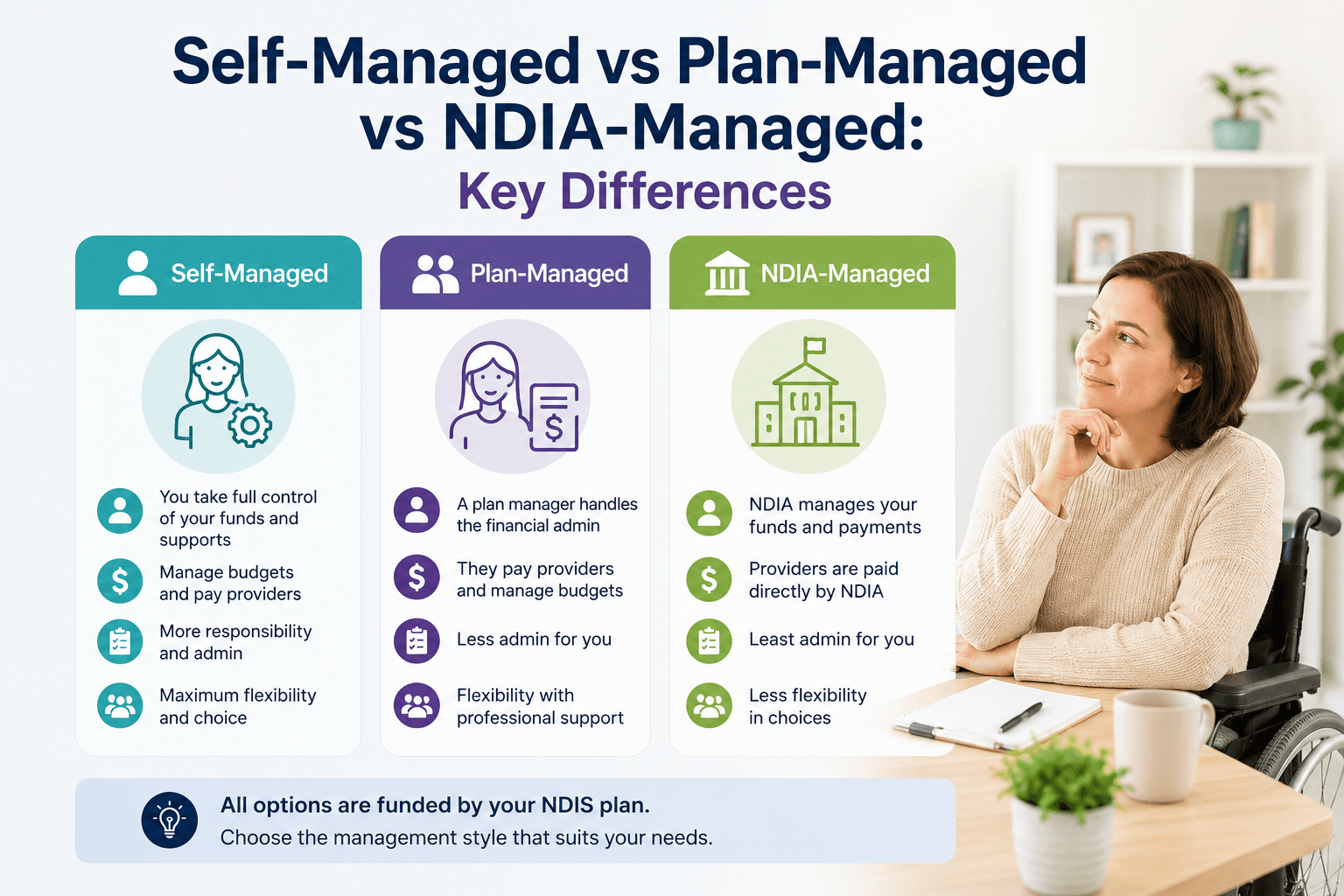
Self-managed means you handle your own NDIS funding, invoices, and provider choices. Plan-managed means a professional plan manager handles the admin for you while you keep full choice of providers. NDIA-managed means the National Disability Insurance Agency pays providers directly, but you're limited to registered providers. You can also mix all three across different parts of the same plan.
Key Takeaways
- Self-management gives you full control and full choice of providers, registered or not, but it comes with real admin work, often 5 to 20 hours a week depending on your plan.
- Plan management gives you the same provider flexibility as self-management without the paperwork, funded separately so it doesn't reduce your support budgets.
- NDIA-managed is the most hands-off option, but it only works with registered providers.
- You can mix management types by budget category within the same plan, for example, plan-manage your Core supports while self-managing Capacity Building.
- The NDIS Amendment (Integrity and Safeguarding) Act 2026 raised the stakes on this decision, with expanded penalties for unregistered-provider misuse and a move to fully electronic claims.
Table of Contents
- The Three Ways to Manage Your NDIS Funding
- Self-Managed: Full Control, Full Responsibility
- Plan-Managed: The Middle Ground
- NDIA-Managed: The Hands-Off Option
- How This Connects to Registered vs Unregistered Providers
- What Changed Under the 2026 Integrity and Safeguarding Act
- A Practical Way to Decide
- Can You Mix Management Types?
- For Punchbowl & Sydney South West Families
- Frequently Asked Questions
The Three Ways to Manage Your NDIS Funding
Every NDIS plan uses one, or a mix, of these three management types:
The right choice depends on how much admin you want to take on, and how much provider flexibility actually matters for your situation.
Self-Managed: Full Control, Full Responsibility
According to the NDIS's own guidance, self-managed funding means you, a plan nominee, or a child representative manages your NDIS funding directly. This gives you real benefits: choice over what supports you buy and who delivers them, the ability to use both registered and unregistered providers, room to negotiate prices above or below the NDIS price guide, and the ability to directly employ or contract your own support staff.
The trade-off is responsibility. You're the one paying providers, keeping invoices and receipts as evidence, making sure your funding lasts the length of your plan, and showing the NDIA how you've used it to pursue your goals when the plan ends. This workload commonly runs 5 to 20 hours a week depending on how complex your plan is, worth being realistic about before choosing this option.
Not everyone can self-manage. The NDIS won't allow it if you're currently insolvent under administration, have been convicted of an offence involving fraud or dishonesty, have been convicted of an offence carrying 2 or more years in prison, or if the NDIA believes self-managing would pose an unreasonable risk to you or that you're unlikely to spend the funding in line with your plan.
Plan-Managed: The Middle Ground
Plan management means a registered, independent plan manager receives your provider invoices, checks they're correct, and arranges payment directly from your NDIS funding, so you're never out of pocket waiting on a claim. Importantly, plan management is funded separately in your plan and doesn't come out of your support budgets, choosing a plan manager doesn't shrink the funding available for your actual supports.
Plan-managed participants keep the same provider flexibility as self-managed participants, both registered and unregistered providers are available, without taking on the invoicing and record-keeping work. This combination of choice plus low admin is exactly why plan management is commonly described as the most popular option among the three.
NDIA-Managed: The Hands-Off Option
NDIA-managed funding, sometimes called agency-managed, means the National Disability Insurance Agency pays your providers directly through the NDIS portal. You don't deal with invoices, payments, or claims at all, which makes it the most straightforward option if you'd rather not think about the financial side of your plan.
The trade-off is provider choice. NDIA-managed participants generally need to use NDIS-registered providers, since the NDIA can only pay suppliers it recognises through its own systems. If you have your heart set on a specific unregistered provider, this management type won't allow it.
How This Connects to Registered vs Unregistered Providers
This decision and the registered-vs-unregistered provider decision are two sides of the same coin. If you're NDIA-managed, you're locked into registered providers regardless of anything else. If you're plan-managed or self-managed, the registered-vs-unregistered choice genuinely opens up. We've covered that decision in full detail, including the current price-cap rules and a real cost example, in Registered vs Unregistered NDIS Provider: The Real Cost, worth reading alongside this guide if you haven't already settled on your plan management type.
What Changed Under the 2026 Integrity and Safeguarding Act
The NDIS Amendment (Integrity and Safeguarding) Act 2026 received Royal Assent on 8 April 2026 and genuinely raises the stakes on parts of this decision, particularly if you're weighing self-management with unregistered providers. According to a detailed breakdown of the Act, the changes include:
- New and higher civil penalties, up to 10,000 penalty units for serious contraventions, including unregistered providers delivering services that legally require registration, and providers falsely claiming they can provide a service that needs registration.
- Expanded powers for the NDIS Quality and Safeguards Commission to issue banning orders across a broader range of people in the NDIS marketplace.
- A move toward a fully electronic claims system, with the NDIA now able to control the method for making claims entirely online.
- A new minimum 90-day cooling-off period for participants who decide to withdraw from the Scheme, during which they can cancel that request.
None of this changes which management type you should pick, but it does mean the stakes of verifying a provider's actual registration status, and of understanding your own paperwork obligations under self-management, are genuinely higher in 2026 than they were before this Act passed.
A Practical Way to Decide
- If you want zero admin and don't mind being limited to registered providers, NDIA-managed is the simplest fit.
- If you want full provider flexibility but don't want to handle invoicing and record-keeping yourself, plan management gives you that without the paperwork.
- If you want maximum control, including negotiating prices and hiring your own staff, and you're comfortable with 5 to 20 hours a week of admin, self-management fits, provided you meet the eligibility requirements above.
- If different parts of your plan have different needs, consider mixing management types by budget category rather than forcing one approach across everything.
Can You Mix Management Types?
Yes. The NDIS explicitly allows you to self-manage part of your plan and have the remainder plan-managed or NDIA-managed, for example, self-managing your Core supports for pricing flexibility while having a plan manager handle your Capacity Building budget. You can ask to change how any part of your funding is managed at any time, and there's no limit on how often you can request this change. This is often done as a simple plan variation rather than a full plan reassessment, so it's less disruptive than it might sound.
For Punchbowl & Sydney South West Families
Families across Punchbowl, Bankstown, and the wider Canterbury-Bankstown area often default to whatever management type they were assigned at their first plan meeting without realising it can be changed, or split, at any time. If your current setup isn't working, whether that's too much paperwork under self-management or too little provider choice under NDIA-managed, it's genuinely worth raising with your Local Area Coordinator.
If English isn't your first language, free interpreter support is available through TIS National on 131 450 when discussing these options with your NDIA planner or Local Area Coordinator.
About This Guide
This guide was written by Merina Suwal, Director and Clinical Services Specialist at Care Steps Australia, who brings more than 10 years of clinical nursing experience across residential aged care and home care settings. This guide draws directly on current NDIS guidance and the NDIS Amendment (Integrity and Safeguarding) Act 2026. Last updated August 21, 2026.
Get in Touch
Care Steps Australia 48 Lancaster Avenue, Punchbowl, NSW 2196 Phone: (02) 8201 3100 Email: info@carestepsaustralia.com.au
Not sure which management type actually fits your situation? Contact Care Steps Australia or explore the full range of NDIS supports we provide across Punchbowl and Sydney's south west. If you're still working through getting your plan approved in the first place, our step-by-step NDIS application guide covers what comes before this decision.
Frequently Asked Questions About NDIS Plan Management Types
Yes. You can ask to change how your funding is managed at any time, with no limit on how often you request it, and this is often handled as a simple plan variation.
No. Plan management is funded separately in your plan and doesn't reduce your Core, Capacity Building, or Capital supports budgets.
No. NDIA-managed participants generally need to use NDIS-registered providers, since the NDIA pays providers directly through its own systems.
It varies, but commonly runs 5 to 20 hours a week depending on the size and complexity of your plan, worth weighing honestly against how much control you actually want.
Yes. You can split management types by budget category, for example, self-managing one budget while another is plan-managed or NDIA-managed.
Higher penalties for unregistered providers delivering services requiring registration, expanded NDIS Commission banning-order powers, a move to fully electronic claims, and a new 90-day cooling-off period for participants withdrawing from the Scheme.
Related service
NDIS support services →Personal care, community nursing, daily living and community participation for NDIS participants.
Request a call back
Tell us a little about the support you need and our team will call you back during business hours. Prefer to talk now? Call 02 8201 3100.


Led by Rosy Thapa (Aged Care Specialist) & Merina Suwal (Clinical Services Specialist), each with 10+ years in aged care and clinical nursing.
- ✓ Registered NDIS provider - approved to Aug 2028 (verify)
- ✓ Registered aged care provider
- ★ 5.0 Google rating - read our reviews