Specialist Disability Accommodation (SDA) in Sydney Explained
By Care Steps Australia
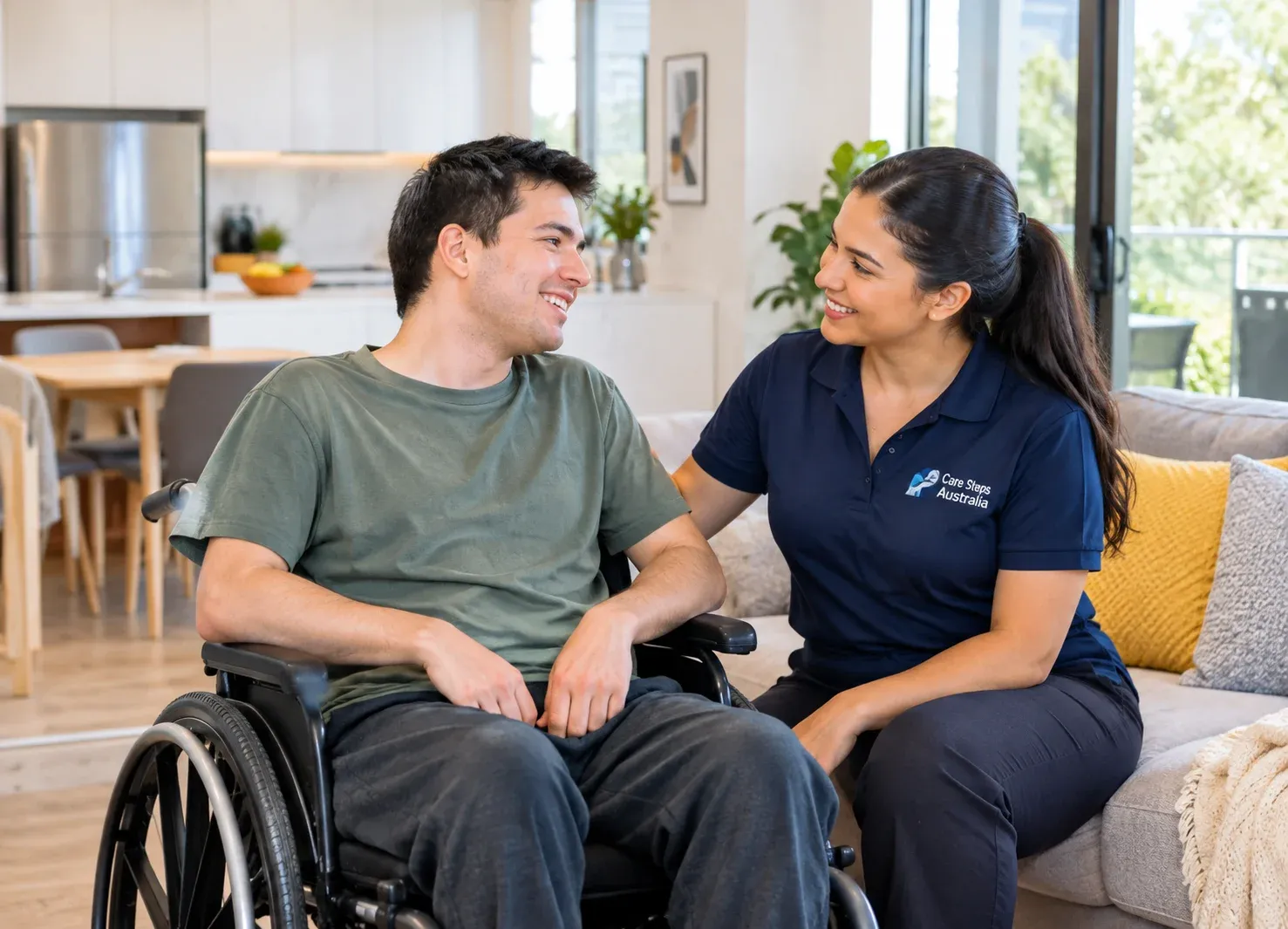
Specialist Disability Accommodation, or SDA, is NDIS funding that pays for purpose-built housing for people with extreme functional impairment or very high support needs. It covers the home itself, not the support workers who help you live in it, and only a small share of NDIS participants qualify. If you're trying to work out whether SDA applies to you or someone you support in Sydney, this guide walks through eligibility, the four design categories, real cost mechanics, and how to start the application process.
Key takeaways
- Specialist Disability Accommodation (SDA) is NDIS funding for the physical home itself, not for the support workers inside it. That's a different funding category from Supported Independent Living (SIL).
- SDA is not for most NDIS participants. The NDIS's own criteria describe eligibility in terms of "extreme functional impairment or very high support needs."
- There are exactly four SDA design categories: Improved Liveability, Robust, Fully Accessible, and High Physical Support. No fifth category exists under the current NDIS Design Standard.
- SDA payments follow maximum price limits set out in the NDIS's own pricing schedule. Actual cost depends on the design category, building type, and location.
- Applying for SDA starts with a conversation with your NDIS planner or support coordinator, backed by clinical evidence that shows SDA is reasonable and necessary for you.
- SDA housing already exists in Sydney's south-west, including properties operating in Bankstown and Punchbowl, which means local demand and local providers are both real, not theoretical.
- SDA and SIL are commonly confused, including by people searching from this exact part of Sydney. They are separate supports and usually need to be applied for separately.
- Care Steps Australia works across Punchbowl, Bankstown, Liverpool, Campbelltown, Campsie, Lakemba, and Greenacre, and can help you work out whether SDA is the right starting point for your situation.
What is Specialist Disability Accommodation (SDA) under the NDIS?
Specialist Disability Accommodation is a category of NDIS funding for housing that's been designed or modified to meet the needs of people with significant disability, separate from any funding for in-home support. The NDIS's own definition describes SDA as accommodation for participants who need specialist housing solutions, including things like wider doorways, reinforced walls and ceilings, or ceiling hoist systems built into the structure of the home.
This matters because SDA is one part of a bigger system, and it's easy to mix up. SDA pays for the dwelling. It doesn't pay for personal care, cleaning, or overnight support workers. Those come from other funding categories, most commonly Supported Independent Living (SIL), which we'll come back to later in this guide because a lot of people searching for SDA are actually asking about both at once.
SDA housing in Sydney takes a few physical forms: standalone houses, duplexes, villas, apartments, and group homes where several participants share a property with on-site support. None of these building types are SDA by default. A property only counts as SDA once it's been enrolled against the NDIS's design standard and matched to a participant whose plan includes SDA funding.
SDA is also one of the NDIS supports restricted to registered providers, which we covered in more detail in our earlier piece on registered versus unregistered NDIS providers. That restriction alone is worth knowing before you start looking at properties, since it rules out a chunk of the wider provider market from the start.
For families in Punchbowl, Bankstown, or across Care Steps Australia's other service areas, the practical starting point is usually working out whether SDA is even the right category to be asking about, which comes down almost entirely to how the NDIS assesses functional impairment.
Who is eligible for SDA funding?
SDA eligibility comes down to one narrow test: the NDIS has to agree you have extreme functional impairment or very high support needs, and that SDA is reasonable and necessary for you specifically. This isn't a general disability threshold. It's a higher bar than most other NDIS supports, which is why SDA appears in a relatively small number of plans compared to something like SIL or core supports.
The NDIS's own eligibility language states that participants need to "have an extreme functional impairment or very high support needs" before SDA funding is considered. On top of that functional threshold, the NDIS also looks at whether your current living arrangement is appropriate, and whether specialist housing would genuinely change your outcomes, not just your comfort.
In practice, this means an SDA request needs to be backed by clinical evidence, usually from an occupational therapist, that connects your specific impairment to a specific type of housing need. A general disability diagnosis on its own doesn't meet the bar. What does is evidence showing, for example, that you need a wheelchair-accessible bathroom with a specific turning circle, or that your support needs require a home built for 24-hour on-site assistance.
This is also where the SDA and SIL confusion tends to start. You can be assessed as needing high levels of daily support (which points toward SIL) without meeting the separate, stricter test for SDA housing itself. The two assessments ask different questions, even though they often get discussed in the same planning conversation. If you're not sure which category actually applies to your situation, that's a conversation worth having early with a local NDIS provider rather than assuming either one on your own.
What are the four SDA design categories?
There are exactly four SDA design categories under the NDIS Design Standard: Improved Liveability, Robust, Fully Accessible, and High Physical Support. Every enrolled SDA dwelling in Australia, including any operating in Sydney's south-west, has to be built to match one of these four categories. There isn't a fifth or a hybrid option.
The NDIS's Design Standard page confirms these four categories, published as the Design Standard in October 2019 and applying to all new and newly refurbished SDA builds from 1 July 2021 onward. Here's what separates them:
The category a home is built to isn't a preference. It's tied directly to the same functional assessment that decides SDA eligibility in the first place, so the design category on your plan and the design category of the property need to match before you can move in.
How much does SDA cost, and what does it cover?
SDA funding pays providers up to a maximum price limit set by the NDIS, based on the property's design category, building type, and location, not a flat fee. The NDIS publishes a dedicated SDA pricing schedule, updated periodically (the current schedule took effect on 24 September 2026), and providers can't legally claim more than the maximum price it sets for a given category and building type.
What SDA covers is the dwelling itself: the build or modification cost, ongoing maintenance obligations tied to the design standard, and the provider's return for delivering compliant housing. It does not cover support workers, food, utilities, or general living costs. Those sit under separate funding, most commonly SIL, Core Supports, or the participant's own income.
To give a real sense of scale, the NDIS's own SDA Pricing Arrangements document (version 3.0, valid from 20 March 2026) sets base annual price limits, before sprinkler and GST adjustments, of roughly $26,652 to $81,962 per participant for Improved Liveability, $28,873 to $83,765 for Fully Accessible, $31,337 to $73,693 for Robust, and $32,142 to $90,978 for High Physical Support, with the exact figure depending on building type and number of residents. On top of the SDA payment itself, participants typically also pay a Reasonable Rent Contribution toward the property, which sat at $516.11 a fortnight for a single participant and $327.05 for a member of a couple between 20 March and 19 September 2026, plus a separate board payment if meals, utilities, and furnishings are included.
These are base figures from one official pricing document, not a full quote, and the NDIS updates SDA pricing periodically (a newer schedule, referenced on the pricing arrangements page, took effect on 24 September 2026). Your actual cost depends on your specific design category, the building type, whether the property has sprinklers, and GST treatment, so the right way to get an exact number is the NDIS's own SDA price calculator or a direct conversation with your planner, not a single figure pulled from an article.
How do you apply for SDA in Sydney? (step-by-step)
Applying for SDA starts inside your existing NDIS plan, not as a separate standalone application. The NDIS's general application process applies to becoming a participant in the first place; SDA specifically then gets requested and assessed as part of your plan.
Here's how that typically plays out for someone applying from Sydney:
- Start with your NDIS planner or support coordinator. Raise SDA directly and explain why your current housing situation isn't working for your support needs.
- Get an occupational therapist assessment. This is the clinical evidence that connects your specific functional impairment to a specific SDA design category. Without this, an SDA request generally doesn't progress.
- Show that SDA is reasonable and necessary. Your planner needs evidence that specialist housing, not just more support hours in your current home, is what actually addresses your needs.
- Wait for the plan review or funding decision. SDA funding gets added to your plan if the NDIS agrees the evidence supports it.
- Find a property matched to your approved design category. Once SDA is in your plan, you (often with a support coordinator) look for an enrolled SDA dwelling built to the right category in the area you want to live.
- Confirm the property and support arrangements together. Since SDA only funds the dwelling, you'll also need to sort out who provides your in-home support, whether that's SIL or another arrangement, before you move in.
Because this process runs through clinical evidence and plan reviews rather than a single form, timelines vary a lot from one person to the next. If you're at the very start of this and not sure what "reasonable and necessary" evidence actually looks like for your situation, getting in touch directly tends to save more time than guessing.
Is Specialist Disability Accommodation available in Bankstown or Punchbowl?
Yes. SDA housing already operates in Sydney's south-west, including properties in both Bankstown and Punchbowl, so this isn't a hypothetical option for families in the area. What's harder to find locally isn't the housing itself, it's a plain-language explanation of how SDA actually works before you get to the property-search stage.
That gap is real. Search for SDA information specific to Bankstown or Punchbowl and you'll mostly find individual property listings, room counts, current housemate details, aimed at someone who already has SDA approved and is ready to move. That's a different stage of the process from where most families start, which is usually with basic questions: does this even apply to us, and what would it take to find out.
Care Steps Australia is based at 48 Lancaster Avenue in Punchbowl and works across the surrounding area, including Punchbowl, Bankstown, Liverpool, Campbelltown, and Campsie, plus Lakemba and Greenacre. If you're earlier in the process than a property search, that local, plan-level starting point is usually the more useful first step.
It's also worth knowing that SDA eligibility and SIL eligibility get assessed separately, even for people living in the same local area. A support coordinator working across south-west Sydney sees this confusion regularly: someone assumes that because they need a lot of daily support, SDA housing must follow automatically. It doesn't. The two are related but distinct parts of a plan, which brings us to the next question directly.
What's the difference between SDA and Supported Independent Living (SIL)?
SDA funds the physical home. SIL funds the support workers who help you live in it. They're separate NDIS categories, assessed separately, and you can have one without the other.
A person might live in an SDA-enrolled property and also have SIL funding for daily support, or they might have SIL funding for in-home support in a home that isn't SDA-enrolled at all, because their disability affects their support needs without meeting the stricter physical-housing threshold SDA requires. Neither combination is automatic. Each has to show up in your plan on its own merits.
This distinction trips up a lot of people searching for information on both topics, and it's a genuinely common mix-up, not a rare one. It shows up in local search behaviour too, where people actively search things like "SIL vs STA NDIS" while trying to sort out which NDIS acronym actually applies to their situation. If you're not sure whether you should be asking about SDA, SIL, or both, that uncertainty is common enough that it's worth raising directly in a planning conversation rather than trying to self-diagnose from acronyms alone.
Getting started with SDA support in Sydney
If you're trying to work out whether SDA applies to you or a family member, the fastest way to get a straight answer is to talk it through with someone who works in this system daily, not to guess from a design category chart alone. Care Steps Australia supports NDIS participants and families across Punchbowl, Bankstown, Liverpool, Campbelltown, Campsie, Lakemba, and Greenacre, and can help you work out what evidence you'd need and whether SDA, SIL, or both are the right conversation to have with your planner.
You can reach out through our enquiry form or contact us directly to talk through your specific situation.
Care Steps Australia
48 Lancaster Avenue, Punchbowl NSW 2196
Phone: (02) 8201 3100
Email: info@carestepsaustralia.com.au
Find us on google maps : https://share.google/3Em22TFRY9QJr3OkP
Frequently Asked Questions about SDA in Sydney
Within limits, yes. Once SDA funding is confirmed in your plan for a specific design category, you can look at any enrolled SDA property built to that category, but your choice is limited to properties that actually match your approved category and support arrangement, not any home on the market.
There's no fixed timeframe, because SDA approval depends on plan reviews and the strength of your clinical evidence rather than a set processing period. A straightforward request with clear occupational therapist evidence tends to move faster through the system than one where eligibility is borderline or evidence is incomplete.
Yes, some SDA properties are self-contained homes for a single participant, while others are group homes shared by several participants with on-site support. Which setup suits you depends on your support needs and personal preference, and it's a separate decision from the SDA design category itself.
If the NDIS decides SDA isn't reasonable and necessary based on the evidence provided, you can request a plan review or provide additional clinical evidence to support a fresh request. A decline usually points to a gap in the evidence connecting your functional impairment to a specific housing need, which is worth addressing directly with your planner or support coordinator before reapplying.
No. A group home is one possible building type for SDA, where several participants share a property, but SDA also includes standalone houses, villas, duplexes, and apartments. Whether a property is a group home or self-contained is about the building type, not the SDA funding category itself.
No. SIL and SDA are assessed and funded separately, so you can have SIL support in a home that isn't SDA-enrolled at all. Plenty of NDIS participants receive SIL support without ever needing or qualifying for SDA housing.
Related service
NDIS support services →Personal care, community nursing, daily living and community participation for NDIS participants.
Request a call back
Tell us a little about the support you need and our team will call you back during business hours. Prefer to talk now? Call 02 8201 3100.
Led by Rosy Thapa (Aged Care Specialist) & Merina Suwal (Clinical Services Specialist), each with 10+ years in aged care and clinical nursing.
- ✓ Registered NDIS provider - approved to Aug 2028 (verify)
- ✓ Registered aged care provider
- ★ 5.0 Google rating - read our reviews